WHAT IS A LASER?
A laser is a special form of light that, unlike ordinary light, consists of a single wavelength and is concentrated into a high-density beam.
WHAT EFFECTS DOES THE LASER HAVE?
The laser we use for closing veins primarily has a thermal effect. The light heats the tip of the glass fibre, and the heat is distributed along the inner wall of the vein.
WHAT EFFECT DOES THE HEAT HAVE INSIDE THE VEIN?
The heat causes the vein to shrink, connective tissue builds up inside the vessel, and the blood inside the vein clots. The final result is the closure of blood flow through the treated vein. Because of this, the vein is no longer under pressure and over time (from 4 weeks to 6 months) becomes invisible. The body gradually breaks it down and removes it.
HOW DOES RADIOFREQUENCY WORK?
Radiofrequency treatment does not use light as a heat source, but rather radio waves. The principle is the same as that of a microwave oven. Everything else is identical to laser treatment. Some patients report less pain after the procedure compared to laser treatment.
IS THE TREATMENT RESULT PERMANENT?
The cause of venous disease lies in a congenital weakness in the structure of the vein wall. Therefore, no method can guarantee complete and permanent cure. With therapeutic procedures, we relieve symptoms, improve appearance, and try to slow down the progression of the disease.
According to available data from abroad and in our country, the success rate of laser treatment is at least equal to that of surgical treatment of varicose veins. The advantage of laser treatment lies in its minimally invasive approach and shorter recovery time. After one year, only a few percent of treated veins remain open and require additional treatment.
WHAT YOU NEED TO KNOW BEFORE LASER SURGERY FOR VARICOSE VEINS
- On the morning of the procedure, take a shower, preferably with disinfectant soap. Do not use body creams or lotions.
- There is no need to shave or depilate your legs. If you normally shave or depilate your lower extremities for aesthetic reasons, we recommend doing so 3–5 days before the procedure.
- Before the procedure, you will be given a painkiller tablet and, if necessary, a mild sedative.
- If you have any allergies to medications, you must inform us in advance.
- Before the procedure, we will prescribe and fit appropriate medical compression stockings (knee-high, compression class 2), which will be put on immediately after the procedure. Do not remove these stockings for at least 24 hours — that means you will wear them until the evening of the following day.
With laser surgery, we will close the main vein through which blood was flowing backward and filling the smaller superficial veins. Once the main vein is closed, the smaller veins will no longer be filled with blood and will shrink again. For this reason, you must wear compression stockings for at least 3 weeks.
- Immediately after the procedure, you will be able to walk. We recommend walking for at least 10–15 minutes right after the treatment. Walk normally so that the calf muscles contract.
- For the first three days after the procedure, avoid heavy tasks that require prolonged standing in one place, long sitting, or exposure to heat. We also advise against intense physical exercise. Light work and sporting activities are recommended. We suggest walking for up to half an hour several times a day.
- If you have a physically demanding job, we recommend taking 1 to 2 weeks of sick leave, depending on the extent of the procedure, your general condition, and the nature of your work.
THE COURSE OF LASER / RADIOFREQUENCY TREATMENT
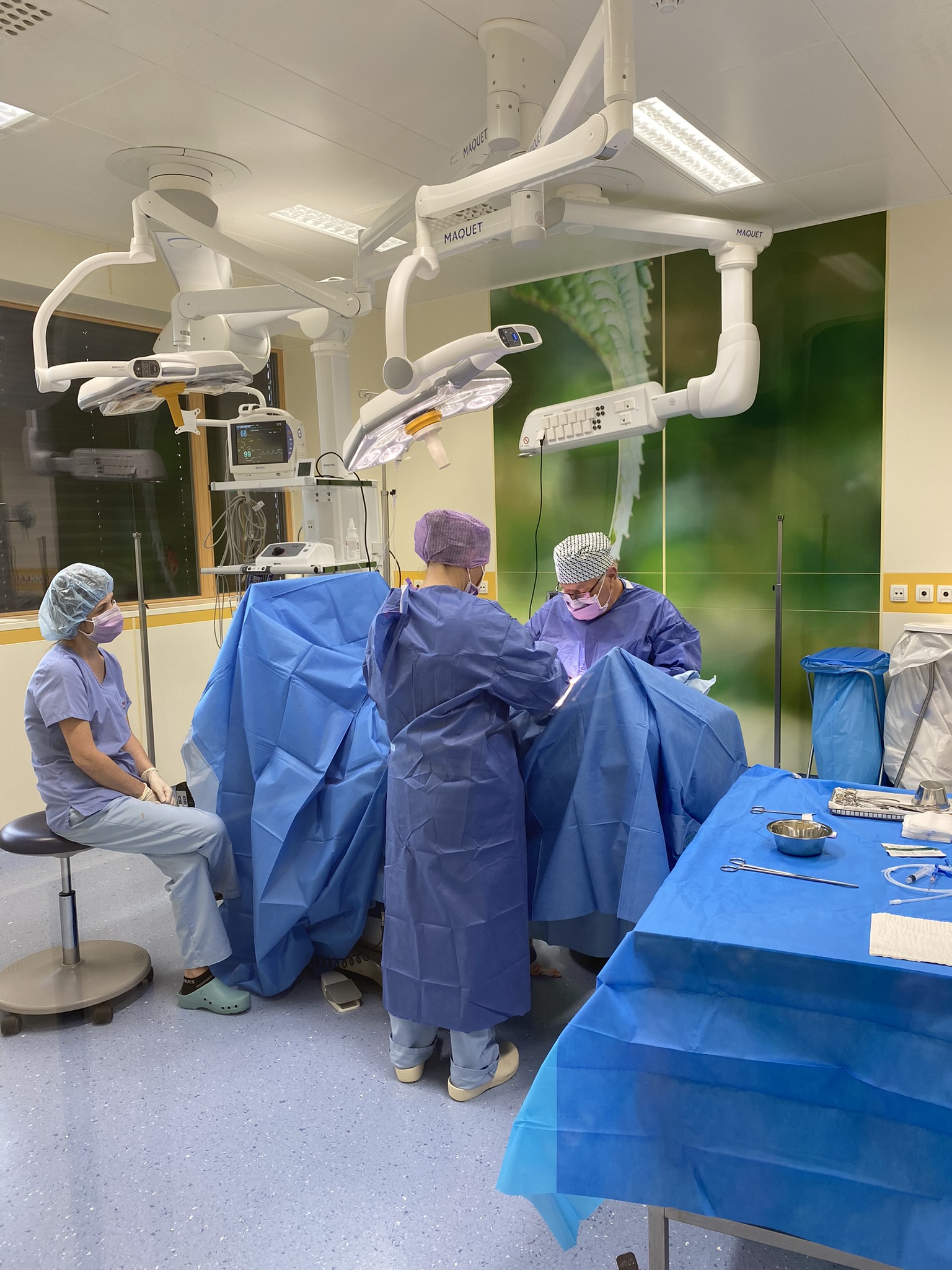
Before the laser procedure, we perform an ultrasound examination of the veins in the affected lower limb. We mark the course of the diseased superficial vein on the skin. Then we prepare you for the procedure. The entire lower limb will be disinfected and the area covered with sterile drapes. Using a small needle, we numb the skin at the puncture site where the laser fibre will be inserted into the vein. During the procedure, we monitor the position of the laser fibre with ultrasound and precisely inject a local anaesthetic around the vein.
You will need 6 to 8 small needle punctures. Then we begin the laser therapy.
Some smaller varices (dilated veins) will be removed during the procedure through tiny skin incisions (phlebectomy). After the procedure, we will put on the compression stockings. In some cases, we also prescribe medication to prevent venous thrombosis.
WHAT SIDE EFFECTS AND COMPLICATIONS CAN OCCUR AFTER LASER SURGERY FOR VARICOSE VEINS?
- Bruising, minor swelling, and a feeling of tightness or pain are normal and usually disappear within a few days.
- During the procedure, we close the main superficial veins, while smaller ones remain as blind pouches. Blood flow in them slows down and the blood may clot. You may feel this as a painful hard lump. There is no cause for concern — the clot cannot travel anywhere and there is no risk of embolism. Cooling, applying heparin cream, and wearing compression stockings usually help. You can also take anti-inflammatory painkillers (e.g. Brufen, Naklofen, Nalgezin).
- Rarely, skin nerves running close to the vein may be damaged. This occurs much less frequently with laser treatment than with traditional surgery. In such cases, the skin may be numb (“dead”) to the touch or touching the area may cause stinging or hypersensitivity. This happens in about 5–10% of patients and usually becomes unnoticeable over time.
- In predisposed individuals, annoying or painful scars (keloids) may form at the sites of tiny incisions. Small nodules or discoloration may also appear, but these usually disappear after some time.
- Healing disorders, infections, formation of blood clots (thrombosis), and consequent embolism are very rare.
Most side effects are temporary. Swelling, redness on the thigh, and pain are the result of tissue damage caused by the thermal effect of the laser. Interestingly, the pain is often strongest 3 to 5 days after the procedure. However, all such difficulties usually disappear within a few days.
For several weeks, you may feel a tender lump under the skin. You may also have a feeling of tightness — this is due to the closure of the large saphenous vein. Over time, the closed vein will be overgrown with connective tissue and will feel like a thin cord under the skin. It usually disappears completely within six months to a year.
WHAT RESULTS CAN I EXPECT FROM THE TREATMENT?
The procedure will eliminate most of the problems you have been experiencing (heavy legs, cramps, swelling, pain, etc.). Your legs will feel light again. The cosmetic appearance of your legs will also improve significantly. Any remaining small spider veins or reticular veins can, if desired, be treated later with sclerotherapy or surface laser.
Varicose veins develop due to weakness of the connective tissue in the veins, which cannot be corrected by laser or surgery. Therefore, it is possible that new varicose veins may appear over the years. In some cases, repeat treatment may be necessary. According to our experience and medical literature, this occurs in 10 to 40% of patients.
IMPORTANT!
Unless we instruct you otherwise, after the procedure you may:
- Get up immediately after the procedure.
- Take several short walks daily or ride a stationary bike.
- Sit and stand in one place as little as possible.
- Never cross your legs.
- Keep your legs elevated when resting.
- Repeat light gymnastic exercises (e.g. lift your extended legs, move your feet up and down).
- Do not remove the adhesive dressings until your first follow-up visit with the doctor.
- After three days, you may take short showers. Bathing, sunbathing, and using the sauna are allowed only after the wounds have fully healed (approximately three weeks).
- If the procedure was performed on an outpatient basis, due to the effects of the medication, you must not:
- drive a vehicle,
- operate machinery,
- consume alcohol for at least six hours after the procedure.
WHEN SHOULD YOU CONTACT THE SURGEON?
After the procedure, we will provide you with a telephone number where you can seek advice if:
- Your body temperature rises above 38 °C,
- You notice significant bleeding that does not stop even after applying sterile gauze and a bandage over the stocking,
- The skin around any stitches becomes red and swollen (possible infection),
- Your skin itches, swells, or you develop a rash (possible reaction to medication or the compression stocking),
- You have any concerns or questions about the procedure or prescribed medications,
- You experience severe swelling, increasing pain, numbness in the leg, or changes in toe colour, especially with a temperature above 38 °C — contact a doctor immediately.
COMPARISON BETWEEN LASER TREATMENT AND CLASSIC SURGICAL TREATMENT
| Aspect | Laser Treatment | Surgical Treatment |
|---|---|---|
| Anaesthesia | Local – local anaesthetic is injected at the puncture site | Spinal injection, or in special cases general anaesthesia (sleep) |
| Hospital stay | Not required – outpatient procedure | Short hospital stay and nursing care required |
| Rest | Recommended for 3 days | Recommended for 1 to 4 weeks |
| Sick leave from work | 7 days | 3–4 weeks |
| Wearing compression stockings | 3 weeks | 3–6 months |