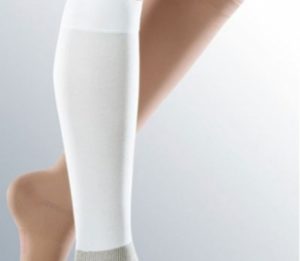
External Compression
External compression is the cornerstone of conservative treatment for chronic venous insufficiency and serves as a supportive and maintenance therapy in all other types of treatment. The vast majority of patients (approximately 75%) with venous disorders can be successfully treated with external compression alone.
Definition
External compression applies pressure to the surface of the lower limb that is sufficient to neutralize the pathologically elevated pressure in the veins of the lower extremities, which causes varicose veins, swelling, and skin changes (5). External compression is only symptomatic treatment.
Pathophysiological Principles of Treatment with External Compression
The main indications for treatment with external compression are disorders of venous and lymphatic circulation and calf edema. The common denominator of all venous flow disorders due to chronic venous insufficiency (CVI) is elevated venous pressure that does not normalize during walking. This is the result of impaired muscle pump function, which may be caused by obstruction of venous outflow (non-recanalized deep vein thrombosis) and/or damage to venous valves in the perforating veins. Valve damage in perforating veins may result from insufficiency in the deep or superficial venous system. Each of these impairments leads to varying levels of pressure in the veins while standing or walking.
Thus, after walking, the pressure in the veins in varicose veins without perforating vein insufficiency (PVI) is approximately 45 mmHg, and in varicose veins with associated PVI approximately 65 mmHg. In post-thrombotic syndrome with outflow obstruction and PVI, the pressure is between 50 and 70 mmHg in stage I CVI, between 70 and 90 mmHg in stage II CVI, and above 90 mmHg in stage III CVI (5). Figure 1 illustrates the venous pressure values at the ankle after walking in various venous flow disorders.
Effect of External Compression
Skin and Extrafascial Tissue
The absence of pressure fluctuation has the greatest impact on the skin and subcutaneous tissue. When pressure is still effective, blood flow through the skin and subcutaneous tissue is impaired. Long-stretch bandages produce very small pressure fluctuations during walking and therefore cause disturbances in skin perfusion and pain. If applied incorrectly, especially if tightened more proximally on the limb, they can cause constriction and superficial venous stasis. Treatment of leg ulcers, lipodermatosclerosis, and edema is therefore only appropriate with short-stretch elastic bandages or inelastic bandages.
Superficial Veins
Phlebographic studies have shown that with external compression of 30 mmHg or more, the great saphenous vein (GSV) trunk is narrowed and flow velocity is increased. It is difficult to completely stop flow through insufficient perforating veins. It has been found that local flow with a compression stocking exerting 40 mmHg pressure is reduced by approximately 30% (5).
Deep Veins
The effect that external compression has on superficial veins is also present in deep veins. However, part of the pressure is absorbed by the soft tissues, so a higher pressure is required to achieve the same effect. In subfascial edema in post-thrombotic syndrome, greater pressure with short-stretch elastic bandages is necessary.
Arteries
Compression bandages with high residual pressure at rest or when lying down can impair arterial flow. Therefore, for continuously worn bandages, the use of inelastic bandages or short-stretch bandages is recommended.
In patients with arterial disorders, external compression may only be used if the post-exercise perfusion pressure is greater than 80 mmHg (5).
INDICATIONS FOR EXTERNAL COMPRESSION WITH MEDICAL COMPRESSION STOCKINGS
Principles
Medical compression stockings are prescribed:
- As the primary and only treatment when other treatments are temporarily or permanently not possible.
- For the prevention of progression of venous disease.
- To prevent recurrence (e.g., leg ulcers).
- When there is a risk of recurrence (e.g., CVI).
- After recurrence has already occurred, to prevent worsening.
Indications and Compression Classes
- Post-thrombotic edema (Class III or IV)
- Pelvic vein obstruction (Class IV)
- Lymphatic edema (Class III and IV, or custom-made compression stockings)
- Post-traumatic edema (Class III)
- Venous malformations (Class III)
- Varicose veins during pregnancy (Class II)
- Chronic venous insufficiency (Class II or III)
- After sclerotherapy of minor varicose veins (Class II)
- After varicose vein surgery (Class II or III)
Contraindications
- When treatment has been successful and there is no longer a need for compression.
- Edema that has not been previously reduced.
- Hypodermitis in the acute phase.
- Very narrow ankles (circumference below 18 cm).
- Arterial flow disorders with perfusion pressure below 80 mmHg (after walking).
- Skin conditions requiring the application of ointments (eczema, mycoses, active leg ulcers) and skin infections.
A certain group of patients, due to other conditions (rheumatic diseases, limited mobility due to arthrosis, neurological disorders, or obesity), are unable to apply medical compression stockings or elastic bandages themselves. Before prescribing external compression therapy, it is necessary to check whether they have adequate assistance.
Effectiveness of External Compression in the Treatment of CVI
Properly selected and applied external compression is considered the most effective conservative treatment method. In patients with smaller leg ulcers of purely venous origin, ulcer healing within four weeks should be achieved in 75% of patients. In reality, such results are rarely achieved. Bradbury and Ruckley report that even in patients included in clinical studies (and thus receiving special care), only 50–60% achieved ulcer healing within 3–6 months (6). However, even in these patients, despite wearing appropriate medical stockings, recurrence occurred in 30% within two years.
It follows that even under the most favorable conditions, the most effective conservative method can be expected to fail in approximately 30% of cases within 3–6 months, and recurrence occurs in 30% of cases within two years after healing.
Selection of External Compression
From the above, it is clear that external compression must be tailored to the pathological process. The pressure exerted by external compression on the superficial veins should neutralize the elevated venous pressure in the superficial veins after walking.
Several options are available for compression. They can be broadly divided into compression bandages and medical compression stockings. For successful treatment, the correct material must be chosen and applied properly. The choice of compression method is in the hands of the physician, while correct application is the responsibility of the patient. The only exceptions are permanent compression bandages and adhesive short-stretch bandages.
Table 1: lists the advantages and disadvantages of the various options (according to Stemmer et al. (5)):
| Type | Medium Compression | Strong Compression | Possibility of Removal | Allergy | Possibility of Constriction | Pressure Dependent on Patient |
|---|---|---|---|---|---|---|
| Inelastic bandages – permanent | – | + | – | – | – | – |
| Inelastic bandages – replaceable | + | – | + | – | + | + |
| Short-stretch bandages | + | – | – | – | – | – |
| Long-stretch bandages | + | – | + | + | + | + |
| Elastic medical stockings | + | – | + | – | – | + |
When choosing the strength of compression, it is important to ensure that the pressure exerted during walking is sufficient to overcome the pressure in the superficial veins. For permanent bandages, the residual compression pressure when lying down should be as low as possible. Therefore, inelastic or short-stretch bandages should be chosen for continuous use.
The pressure exerted by conventional long-stretch elastic bandages on the limb surface depends on the tightness of application. Incorrect application can lead to constriction and disturbances in venous flow. Since elastic bandages are mostly applied by the patients themselves, the risk of incorrect application is high. For this reason, medical elastic stockings are being used more frequently, while elastic bandages are used only immediately after sclerotherapy or surgical treatment. Properly fitted medical compression stockings provide a graduated pressure from the thigh toward the ankle (physiological funnel shape).
The pressure exerted by medical compression stockings on the calf is also standardized. According to the standard of German medical stocking manufacturers (GZG), there are four classes of medical compression stockings (Table 2).
Table 2: Compression Classes of Medical Stockings according to GZG (5)
| Class I | 18,4 – 21,2 mmHg |
| Class II | 25,1 – 32,1 mmHg |
| Class III | 36,4 – 46,5 mmHg |
| Class IV | > 59 mmHg |